
Taking CRM further: AI makes the difference
Anyone who wants to succeed today needs to create experiences that work consistently, seamlessly, and in real time across all channels. Modern CRM systems provide the ideal foundation for this. With the use of Artificial intelligence (AI), they evolve into intelligent, connected platforms that recognize relationships, independently trigger actions within defined processes, and provide proactive support. This fundamentally transforms the role of CRM, turning artificial intelligence into a central driver of the customer experience.
How AI is transforming CRM
CRM systems are designed to centralize data, standardize processes, support collaboration, and enable reliable predictions. AI takes CRM to a whole new level with digital intelligence, automation, and data-driven decision support.
In CRM, AI takes on a central role across sales, marketing, and service processes: It analyzes large volumes of data in real time, delivers predictive insights, optimizes lead scoring, and enables precise, automated customer engagement.
Based on a consolidated, system-wide data foundation, a holistic 360-degree view of customers is created – the so-called Golden Record in the sense of a Single Source of Truth. This forms the basis for cross-channel, context-based real-time decision-making. In this way, CRM evolves into a learning, connected platform that intelligently orchestrates interactions, noticeably relieves processes, and acts as a central driver of consistent, seamless, and engaging customer experiences.
Advantages of AI in CRM
Artificial intelligence in CRM reduces routine workloads and costs, improves decision-making quality, and enables highly personalized customer experiences. Additional benefits can be seen, among other areas, in:
- Lead qualification: AI automates pre-qualification, enriches leads with external information, and evaluates them in real time, allowing sales teams to focus on the most promising contacts.
- Marketing: Targeted, cross-channel, and highly personalized real-time engagement across the entire customer journey.
- Sales: AI continuously analyzes customer relationships, identifies needs for action at an early stage, and provides concrete recommendations for prioritizing opportunities, assessing closing probabilities, and defining optimal follow-ups.
- Project management: AI can automatically create or summarize meeting minutes and project schedules and, through predictive analytics, identify bottlenecks, delays, and risks at an early stage.
- Service and support: AI automatically categorizes, prioritizes, and distributes requests, answers standard inquiries via AI chatbots, and uses sentiment analysis to detect potential dissatisfaction and notify the person responsible.
- Management: AI provides precise predictions, automated reporting with actionable recommendations, and early warnings of risks such as customer churn, including scenario analyses.
AI today, agentic AI tomorrow
The demands for speed, relevance, and personalized communication are steadily increasing. With agentic AI, a new generation of AI solutions emerges that not only analyze or react, but can independently plan, decide, and act. The focus is shifting from isolated automation to intelligent, context-aware, and learning systems across the entire customer journey.
Agentic AI refers to AI systems that operate in the form of autonomous agents. They independently pursue goals, perceive their environment, make decisions, and execute actions, with the ability to continuously adapt their behavior based on feedback. In contrast to traditional AI applications, they are not limited to individual functions but integrate perception, analysis, action, and learning into a closed-loop system.
AI in CRM: requirements, opportunities, and challenges
When introducing and using AI-powered CRM solutions, certain organizational and legal frameworks must be taken into account. Common challenges include distributed, inconsistent data structures, missing consent and governance models, and parallel logic existing in marketing, automation, and service systems, which can hinder seamless end-to-end usage.
In addition, there are often concerns regarding complexity, lack of expertise, and potential data risks. With modern CRM solutions that already provide AI functionalities with minimal implementation effort and do not require deep technical expertise, these barriers can be easily overcome. It is therefore crucial to start in a pragmatic way with clearly defined use cases and measurable goals so that initial results become visible quickly and usage can be expanded step by step. From individual use cases, an integrated overall system gradually emerges for consistent and high-quality customer experiences across the entire customer journey.
At the same time, data protection and regulatory requirements must not be neglected. In particular, in the context of the EU AI Act, transparency is essential:
customers should be informed when they are interacting with an AI. Especially in the case of sensitive decisions, humans should continue to take responsibility (human in the loop). It is advisable to choose a CRM provider that prioritizes data protection, security, and digital sovereignty, ensuring that control over how AI functionalities are used in internal processes is always maintained.

AI in CAS CRM
The use of AI in CRM delivers its greatest value when individual functions are seamlessly integrated. From intelligent content creation and automated processes to autonomously operating workflows: The digitally sovereign CAS CRM solutions CAS genesisWorld und SmartWe place the highest emphasis on data protection and offer a wide range of functions within a single platform.
AI connect: efficient content creation and editing
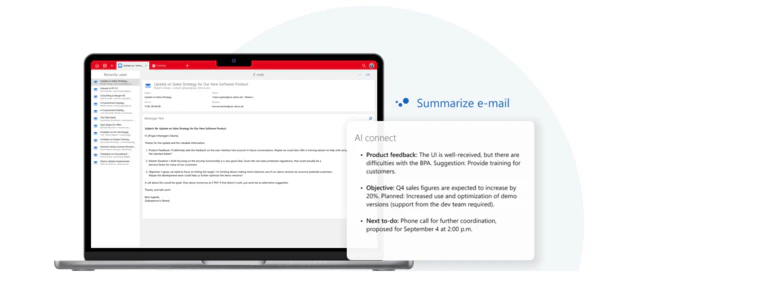
AI connect is the central, data-protection-compliant interface for text-based AI support. Whether creating text, summarizing, translating, or adjusting tone, the editor provides various functions to quickly and effectively optimize content.
What does that mean for you? For example, sales employees can summarize incoming inquiries or conversations, generate personalized responses and offers, or have e-mails adjusted to the desired corporate tone. This saves time, improves communication quality, and ensures consistent customer experiences across all touchpoints.
AI in Business Process Automation
AI connect unfolds its full potential in combination with Business Process Automation and thereby forms the first stage of intelligent agents. Requests received, for example via e-mail, web forms, or campaigns, act as triggers that initiate an automated workflow. With AI text, for example, responses can be drafted via e-mail and sent directly to the appropriate recipient.
Through AI categorization, texts are analyzed using AI based on defined terms, attributes, and classification logic in order to dynamically select the appropriate process path and correctly classify customer requests.
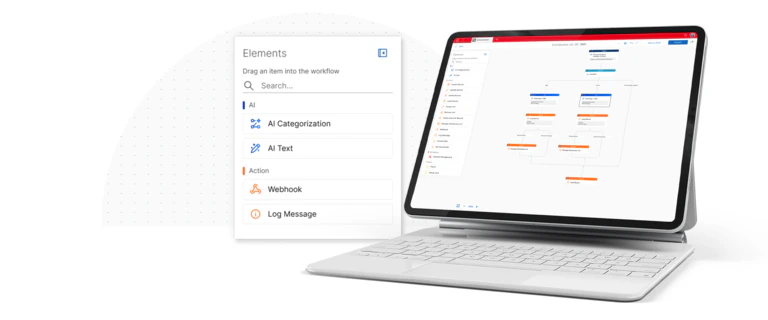
A use case: If the system detects terms such as “support issue” or “error message,” the request is automatically assigned to the service department. If the request relates to “pricing,” “demo,” or an “extension,” an opportunity is identified. Is the tone of the message neutral, positive, or already critical? Accordingly, the priority is adjusted or an escalation is triggered.
The key value: requests are no longer manually sorted but intelligently classified, prioritized, and followed up with appropriate workflow actions such as:
- In service, tickets are created and pre-sorted automatically, and suitable solution articles are suggested directly.
- In sales, leads are qualified and assigned to the appropriate contact person, and appointment suggestions are automatically sent to the prospect.
- In marketing, a newsletter subscription can be initiated.